


Institutional capital is moving from commitment to deployment via coordinated efforts, and the results are starting to show. Malaysia’s economy entered 2026 in a stronger position than most had forecast as gross domestic product (GDP) grew by 5.2% in 2025. The ringgit became Asia’s best-performing currency against the US dollar, and the benchmark KLCI index gained 11.7% in the past 12 months, outperforming the MSCI World.
But a show of resilience in the present does not guarantee competitiveness for the future. Historically, Malaysia has participated in global value chains without fully capturing the value generated, leaving intellectual property, engineering talent and the highest-margin activities elsewhere. Policymakers face a structural question: how can capital be mobilised not merely to generate growth, but to build enduring national capability?
The answer may lie in long-term potential capital and it requires discipline and coordination in execution. That is the gap that GEAR-uP was designed to fill.
Under the Ministry of Finance’s GEAR-uP programme, six government-linked investment companies (GLICs) have committed to deploying RM120 billion in domestic direct investments over five years. The six are the Employees Provident Fund (EPF), Permodalan Nasional Bhd (PNB), Kumpulan Wang Persaraan (Diperbadankan) [KWAP], Khazanah Nasional, Lembaga Tabung Haji and Lembaga Tabung Angkatan Tentera. The programme, which started in August 2024, is well into its execution phase and what makes it distinct is its premise: the institutional capital can complement government spending by investing in areas of national importance where public policy objectives and long-term commercial returns are mutually reinforcing.
Instead of channelling funds through the fiscal budget, GEAR-uP mobilises capital already sitting on government linked-investment companies’ (GLICs) balance sheets. The objective is not to substitute for government spending, but to complement it by deploying long-term capital into areas where national priorities and sustainable investment opportunities align. In doing so, it creates patient capital that can absorb risk, support capability-building and remain invested through multiple economic cycles.
The GLICs mobilising capital beyond government spending
Three institutions are leading this effort, each covering a distinct stage. Khazanah is building Malaysia’s innovation ecosystem and frontier technology capabilities. KWAP is deepening the private market infrastructure that growth-stage companies and long-term assets need to attract serious capital. PNB is developing Bumiputera enterprises through to public market maturity, ensuring the returns of that journey reach Malaysian unitholders. Each holds a different role and together, reflecting both their mandate and investment strengths, collectively covering the broader landscape of what Malaysia needs to build.
Khazanah’s contribution to GEAR-uP flows through Dana Impak, which is a RM6 billion allocation for 2024 to 2028 and is designed to support Malaysian companies across their growth journey while building the strategic ecosystems Malaysia needs to compete.
At the earliest stage, Jelawang Capital backs new Malaysian fund managers through its Emerging Fund Managers Programme, providing capital and platform support to help them build a track record. Around RM300 million has been mobilised through Jelawang Capital initiatives to date, with external investors co-investing alongside. The startups emerging from this pipeline reflect genuine ambition: Aonic, a Malaysian drone solutions company now operating across 15 countries, and DF Automation, founded by Universiti Teknologi Malaysia alumni, whose autonomous mobile robots are now deployed by manufacturers worldwide.
Further up the lifecycle, Khazanah is addressing the “Missing Middle”, which are mid-tier companies that account for 36% of Malaysia’s GDP and 16% of national employment, yet rarely scale into regional champions. Through the MTC Growth Innovation Programme and ELEVATE, run in partnership with the Securities Commission Malaysia, more than 50 Malaysian companies have received structured support to sharpen their growth strategy, improve investor readiness and build long-term capability.
At the frontier, Khazanah is investing directly into Malaysia’s semiconductor and deep-tech ecosystem, alongside three other GLICs, i.e., EPF, LTAT and LTH. Newly Main Market-listed SkyeChip employs over 300 specialised chip design engineers and holds more than 100 patents in artificial intelligence (AI) and high-performance computing. Khazanah’s investment in semiconductor player Syntiant brings a new manufacturing and R&D facility to Penang, creating 800 high-tech jobs and embedding frontier capabilities into Malaysia’s industrial base.
Unlocking Malaysia’s private market opportunity by strengthening the capital infrastructure needed to support high-growth companies and long-term assets, KWAP’s Dana Perintis, launched in 2023, provides early-stage capital to Malaysian startups with an allocation of up to RM500 million. To date, 38 companies have been supported through direct and indirect investments totalling approximately RM300 million, among them Bateriku and Lapasar, each building businesses in energy services and business-to-business commerce.
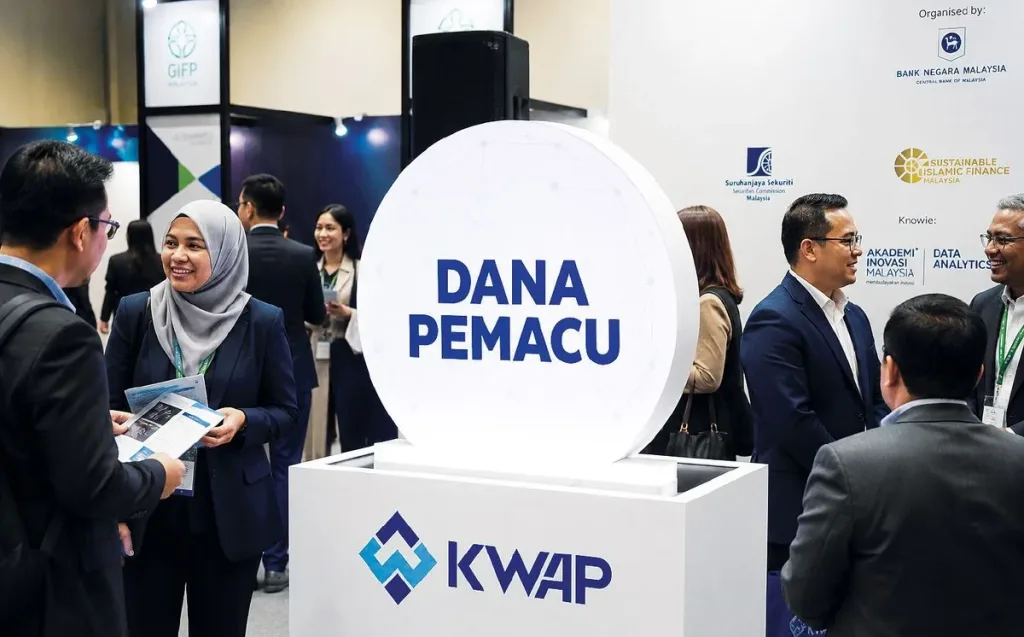
Dana Pemacu operates further up the lifecycle, anchored by a RM6 billion commitment from 2024 to 2029, with the majority of its investments directed towards Malaysia and Shariah-compliant opportunities. Its Co-General Partner (co-GP) model pairs globally established private market managers with local Malaysian talent, embedding international institutional processes and sector expertise into the domestic market. Twelve co-GPs have been nominated, with approximately RM355.5 million deployed to date. I Squared Capital, a global infrastructure investor, is working alongside Quantum Infrastructure Partners on data centre development, renewable energy and transmission infrastructure. Meanwhile, Catenary Capital is strengthening Malaysia’s manufacturing ecosystem by developing four Centralised Labour Quarters across the Klang Valley with a combined development value of approximately RM800 million.
Complementing Dana Pemacu is KWAP’s dedicated climate investing platform, Dana Iklim+, a RM2 billion multi-asset strategy to be deployed from 2026 to 2030, targeting high-impact opportunities across infrastructure, private equity, real estate and nature-based solutions. Already in motion through KWAP’s first announced Dana Iklim+ investment of up to RM190 million into Lestari Cooling Energy, the fund aims to scale sustainable infrastructure while mitigating or reducing up to one million tonnes of carbon dioxide equivalent, advancing KWAP’s role in Malaysia’s industrial and environmental transition.
PNB’s contribution to GEAR-uP is most visible when companies approach mid-growth IPO stage, where a business built through private ownership is ready to meet public markets. Orkim Berhad illustrates how this pipeline works. Under the stewardship of PNB’s subsidiary Ekuiti Nasional Berhad (Ekuinas), Orkim grew into one of Malaysia’s established clean petroleum product tanker operators, expanding its fleet to 18 vessels and supporting over 456 jobs. When the company was ready, PNB supported its transition to Bursa Malaysia’s Main Market in 2025. The IPO generated gross proceeds of RM828 million for Ekuinas, of which RM350 million was returned to PNB as dividends that flowed directly to unitholders, which forms part of their aim in connecting corporate value creation to the financial wellbeing of everyday Malaysians. This is the GEAR-uP pipeline made concrete: private equity incubation, institutional stewardship, public market listing and returns that reach Malaysians.
On industrial infrastructure, PNB, working with its strategic portfolio companies, namely SD Guthrie Bhd and Sime Darby Property Berhad (SDP) are developing long-term assets aligned with Malaysia’s 13th Malaysia Plan and New Industrial Master Plan 2030. The Kerian Integrated Green Industrial Park in Perak targets green electrical and electronics manufacturers, integrating renewable energy infrastructure within a master-planned facility. A proposed industrial and logistics hub on Carey Island in Selangor would leverage strategic landbank to develop diversified industrial capacity in the greater Klang Valley.
A trio’s actions to create collective impact
Viewed individually, the programmes run by Khazanah Nasional, KWAP and PNB, as well as EPF, LTH and LTAT, are each substantial but viewed together, they form something more purposeful. It is a coordinated system of institutional capital covering every stage of Malaysia’s economic development agenda. From seeding the innovation ecosystem, to deepening private market infrastructure, to completing the pipeline through public market maturity and delivering returns to millions of unitholders.
Although GEAR-uP is still in its execution phase, and the full impact of these investments will take years to be felt, early evidence points in the right direction. As startups are scaling, mid-tier companies strengthening, private market infrastructure deepening and Bumiputera enterprises reaching public markets, the foundations for Malaysia’s next phase of economic growth are being laid. And for the first time, in some time, they are being laid with genuine coordination right behind them.
This article originally appeared in The Edge on 22 June 2026; click here to read it.