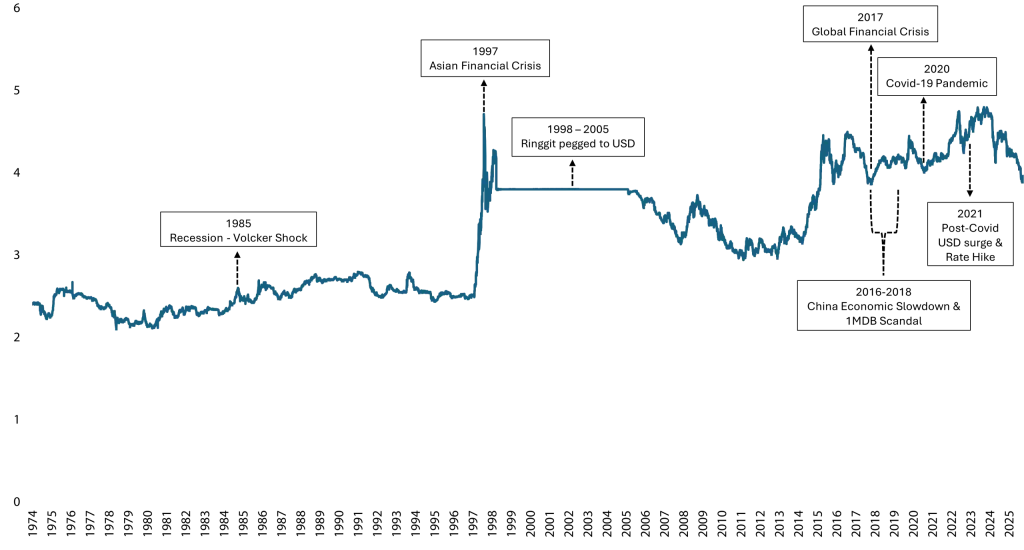



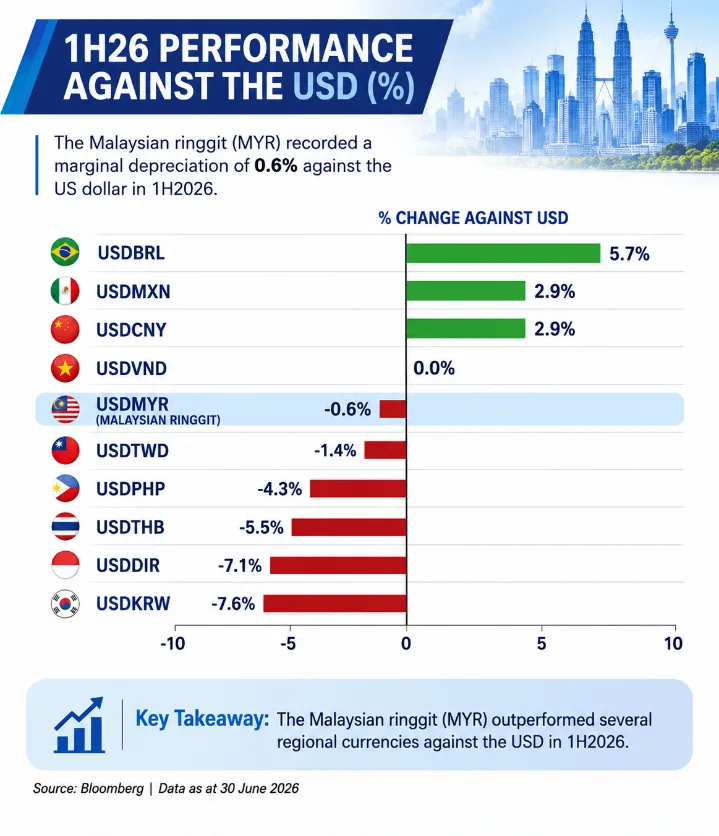
In foreign exchange markets, a single day can feel like an eternity. After closing 2025 as Asia’s top-performing currency and briefly breaking the psychological 4.00 level against the US dollar during its Golden Jubilee , the Ringgit is now undergoing a grinding test of resilience against a protracted dollar upcycle. Yet this cyclical pressure is unfolding alongside a deeper structural shift, as Malaysia moves beyond merely “waiting out” external shocks and repositions itself from a transient trading hub towards a more durable investment destination that is better able to absorb sustained volatility.
In that context, capital is increasingly being anchored through institutional powerhouses such as Kumpulan Wang Persaraan (Diperbadankan) [KWAP] and the Ministry of Finance (MOF)’s Government-linked Enterprises Activation and Reform Programme (GEAR-uP), a collaborative initiative with Khazanah that is helping the nation build a “home-court advantage” that extends beyond short-term stimulus into deeper structural support for growth. It creates a psychological and financial floor for the currency that external volatility can no longer easily shake. Large and volatile capital flows can destabilise even fundamentally sound currencies. The lesson is clear: sustainable currency strength rests on strong domestic capital formation. Keeping long-term funds anchored at home is not just prudent but also strategic.
If sustained, such measures do more than stimulate growth; they uplift confidence, stabilise capital flows, and provide durable support for the Ringgit.
Beyond capital management, a crucial pillar supporting the Ringgit is the proactive creation of demand for the currency itself. Foreign Direct Investment (FDI) inflows may capture the spotlight, but Domestic Direct Investment (DDI) is just as vital for sustaining the strength and stability of the Ringgit. Recognising the need to stimulate domestic investment and bolster economic activity, the Ministry of Finance’s GEAR-uP programme brings together six leading Government-Linked Investment Companies (GLICs). Collectively, they have committed a total of RM120 billion, equivalent to 6.5% of GDP, over the next five years, with KWAP pledging RM40 billion to Malaysia’s private sector. By channelling these resources, GEAR-uP aims to scale up domestic investment, strengthening local economic resilience, and supporting sustainable growth. As a result, Malaysia and the rest of the world secure a decisive edge in mooring domestic investment and stabilising the currency.
Domestic investment, particularly in infrastructure, technology, and other productivity-enhancing sectors, does more than stimulate growth; it preserves capital at the core. When long-term funds are deployed into tangible domestic assets, they are effectively locked into the real economy, reducing the propensity for capital flight during periods of external volatility.
The immediate implication is technical but important: reduced structural selling pressure on the Ringgit. Unlike short-term portfolio flows, DDI is patient capital. It signals conviction in the country’s long-term prospects and strengthens market confidence in Malaysia’s economic fundamentals.
More importantly, strong domestic commitment often crowds in foreign partners. Global investors are more inclined to co-invest when local institutions lead from the front. In that sense, domestic direct investment does not compete with foreign direct investment; it de-risks it.
As capital becomes increasingly anchored domestically, initiatives like GEAR-uP play a pivotal role in bolstering Malaysia’s economic robustness and supporting sustainable growth. The Ringgit’s strength is therefore not merely cyclical or externally driven. It is increasingly underpinned by deliberate capital formation at the centre.
However, a reality check is in order. Downside risks are building. The ‘home-court’ advantage is now facing its toughest test yet amid the Middle East crisis. Historically, such shocks trigger a flight to the US dollar, driving capital outflows and putting emerging market currencies like the Ringgit under pressure. Thus, initiatives such as GEAR-uP are needed to build our defensive shield for the Ringgit and a launchpad for recovery.
Headwinds are likely to intensify, but we are well positioned to navigate them without being derailed. We need to keep our focus on building sturdy domestic foundations, deepening capital accumulation, and sustaining investment in high-value sectors. By doing so, Malaysia can weather external shocks while reinforcing the long-term narrative: the country is not just a trading hub, but a base for sustained, strategic investment.
Domestic economic grit makes for a compelling narrative. But in currency markets, interest rate differentials still do the heavy lifting. With Bank Negara keeping the OPR steady at 2.75%, the yield disadvantage of holding the Ringgit has yet to fully dissipate, particularly if the Federal Reserve resumes raising interest rates. Even so, as the global rate cycle evolves, Malaysia’s strengthening domestic fundamentals could elevate the Ringgit from a purely defensive allocation to a higher-quality carry trade, reinforcing its appeal to global investors.
Securing capital is only half the battle, and that capital must also perform. For the resilience to be durable, DDI cannot simply be a matter of ‘patriotic parking.’ It must earn its yield. When domestic assets yield more than foreign alternatives, the ‘structural selling pressure’ on the Ringgit does not just ease; it can reverse. Notably, superior returns are seldom accidental; they are typically the dividend of a transforming economy.
In the short term, the Ringgit will fluctuate as no currency is a one-way street. However, trends do not lie; the current resilience of the Ringgit is a symptom of strengthening developments in the financial markets. Efforts to raise the ceiling of the domestic economy through infrastructure renewal, technological upgrading, and sustained capital build-up have given it a new underlying support. Volatility may persist, but the direction of travel is becoming clearer: a stronger, more resilient currency, anchored by capital formation and policy-driven certainty.
The key message is clear: while the Ringgit’s volatility against the US Dollar is an inevitable short-term reality, the underlying trend is an evolution. The Ringgit is transitioning from a speculative trading proxy into a long-term investment asset backed by stronger domestic fundamentals.
The Ringgit’s major turning points