


As Malaysia seeks to accelerate investment into high-growth sectors, the challenge is no longer securing capital but deploying it at scale while maintaining commercial discipline. Two years after the Ministry of Finance (MOF) launched the Government-Linked Enterprises Activation and Reform Programme (GEAR-uP), the numbers are beginning to show what domestic institutional capital looks like once it moves beyond the commitment stage.
The programme brings together six government-linked investment companies (GLICs) — the Kumpulan Wang Persaraan (Diperbadankan) [KWAP], Employees Provident Fund (EPF), Permodalan Nasional Bhd (PNB), Khazanah Nasional Bhd, Lembaga Tabung Haji (LTH), and Lembaga Tabung Angkatan Tentera (LTAT) — which have collectively committed to allocate and deploy RM120 billion in domestic direct investments between 2024 and 2028.
“In 2025, KWAP allocated and deployed RM5.4 billion domestically as part of the wider RM20.3 billion deployed by six GLICs, signalling how institutional capital can support Malaysia’s high-growth sectors while remaining anchored in commercial discipline.
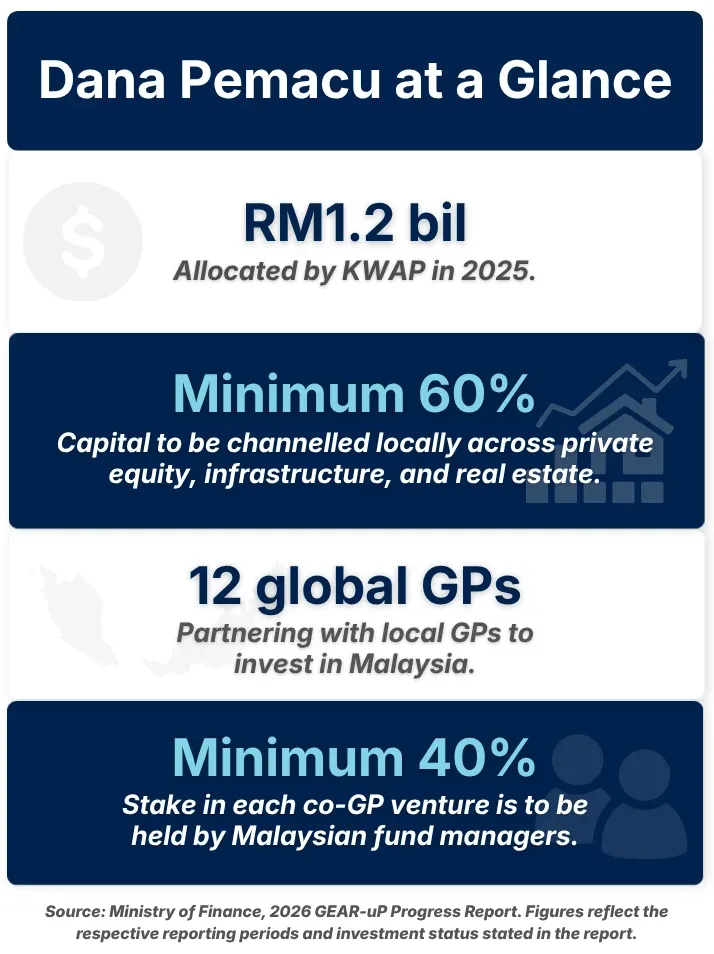
Part of KWAP’s deployment was channeled through Dana Pemacu, its RM6 billion five-year private markets programme spanning private equity, infrastructure, and real estate. In 2025 alone, RM1.2 billion was allocated across 12 fund managers.
For KWAP, Dana Pemacu is more than just an investment programme. Dato’ Jay Khairil Jeremy Abdullah, chief executive officer of KWAP, said the programme also has a longer-term role in developing Malaysia’s fund-management industry.
“Dana Pemacu is often associated with KWAP’s investments in private-market companies, but its objective is broader than that. The initiative is also intended to strengthen the capabilities of Malaysia’s domestic fund-management industry over the long term,” says Dato’ Jay Khairil at a recent GEAR-uP Report Card media briefing.
Some of the most visible investments are in infrastructure.
In Johor, KWAP deployed RM254 million through Singapore-based infrastructure investment fund Seraya Partners into Empyrion Digital’s hyperscale and artificial intelligence data-centre campus. The project is being developed as a 200-megawatt (MW) campus across five buildings, with first energisation targeted for November 2026.
In Selangor, another RM319 million has been committed alongside TrustCapital Malaysia towards a cloud and data-centre development in Selangor. Operated by Pearl Computing Malaysia Sdn Bhd, an affiliate of technology giant Google, the facility forms part of a US$2 billion development. KWAP’s portion is allocated for 2026 and 2027.

The two investments sit at different stages. The Empyrion capital was deployed in 2025, while the investment remains part of KWAP’s allocation for 2026 and 2027. As GEAR-uP moves further into delivery, the distinction between committed capital and deployed capital will become increasingly important.
Beyond infrastructure, Dana Pemacu also invests in essential social infrastructure to address broader social needs.
RM210 million has been allocated for 2026 towards building the first phase of a Centralised Labour Quarter development in the Klang Valley. The first phase will provide 9,000 beds, while the wider development covers four projects with capacity for 28,800 beds and a gross development value of about RM600 million.
Logistics and supply chain are further along.
KWAP allocated and deployed RM279 million in 2025 with Singapore’s real estate giant Mapletree Investments Pte Ltd into a five million sq ft Grade A logistics hub in Shah Alam, within the Bukit Raja-Klang corridor and with direct access to Port Klang.
“Through our investment in this modern logistics infrastructure, KWAP is supporting Malaysia’s continued economic growth by strengthening the supply chain backbone that serves one of the nation’s fastest-growing population centres,” Dato’ Jay Khairil says.
Other investments include RM51 million deployed into Bio-Science Nutraceutical Holdings Sdn Bhd, through local general partner (GP) Mekar Capital Sdn Bhd and global GP Navis Capital Partners, supporting a Malaysian nutraceutical business.
The investments range widely from data centres and logistics to healthcare and worker accommodation. For the civil service pension fund, the common thread is whether the opportunity makes commercial sense and can add capacity to the domestic economy.
Bringing other investors with it
Just as important as where the capital is deployed is who invests alongside KWAP.
Its co-General Partner (co-GP) model pairs Malaysian fund managers with established global partners. The GEAR-uP report names Nexus Point, I Squared Capital, and TrustCapital Advisors Investment Management Pte Ltd among the managers involved, bringing international networks, sector expertise and cross-border deal flow into investments in Malaysian companies.
For KWAP, the partnerships are intended to bring more than capital.
“Companies receiving investment also benefit from the networks and expertise of the global GPs, including access to business opportunities. At the same time, these partnerships help local fund managers strengthen their investment processes, governance and risk management,” Dato’ Jay Khairil says.
There is a deliberate local element to the structure. Dana Pemacu requires Malaysian fund managers to hold a meaningful 40% stake in each co-GP venture, while at least 60% of the capital is to be deployed in Malaysia.
The objective is not merely to involve Malaysian fund managers in individual transactions, but to help build enduring investment capabilities. Working alongside larger international managers allows them to build a track record, strengthen their investment capabilities, and develop networks that could help them raise capital independently over time.
KWAP, meanwhile, does not intend to be the only source of that capital.
“The approach also allows KWAP’s capital to serve as a catalyst for broader private sector participation, expanding the pool of financing while avoiding the displacement of private capital,” Dato’ Jay Khairil adds.
That principle runs through the broader GEAR-uP programme. Of the RM20.3 billion allocated and deployed by GLICs in 2025, RM2.6 billion went into vehicles structured to bring in capital from private managers, agencies and the capital markets. The report describes the financing journey as a “relay race”, with companies moving from venture capital to growth funding and, eventually, the public markets.
KWAP takes an earlier leg of that race through Dana Perintis, its RM500 million venture-capital programme for 2024 to 2028.
Together with Khazanah’s Jelawang Capital, the two platforms allocated and deployed RM588 million into early-stage companies in 2025, largely through fund managers.
A company that secures its first round of funding will eventually need another investor as it grows. The investor taking the next leg does not have to be the same one. What matters is that each stage of funding is available when needed, allowing companies to scale without interruption
A longer bet on climate
The same investment philosophy is also being applied to climate-related opportunities through Dana Iklim+, KWAP’s dedicated climate investment platform.
Dana Iklim+, its RM2 billion multi-asset climate fund, runs from 2026 to 2030, with at least half of the capital targeted for deployment in Malaysia. The fund invests across infrastructure, real estate, private equity and nature-based solutions.
One of its early investments is Lestari Cooling Energy Sdn Bhd, an energy-efficient cooling platform that combines KWAP’s capital with an American investment firm Stonepeak’s infrastructure investment expertise and KJTS Group Bhd’s technical capabilities.
KWAP has allocated RM191 million for 2026 and 2027, alongside an additional RM1.3 billion raised by Stonepeak.
There are already some early operating results. Between January and April 2026, completed retrofits reduced electricity consumption by about 663,000 kilowatt-hour (kWh) and cut carbon emissions by an estimated 491 tonnes, equivalent to a 31.9% reduction in electricity use before and after the works.
Dana Iklim+ has a much larger target: to reduce or avoid up to one million tonnes of carbon dioxide equivalent over the life of the fund. That target is still some way off, but the Lestari figures provide an early indication of how the investment is performing on the ground.
The harder part comes next
GEAR-uP is now moving into its next phase of implementation.
With deployment underway across a range of sectors, focus is increasingly shifting towards the effective deployment of the remaining committed capital and the delivery of long-term outcomes. As the MOF’s GEAR-uP report notes, this is about “putting what has been committed to work, in the right form, and seeing it through”.
For KWAP, that does not mean investing simply to keep pace with a target.
The fund managed RM195.3 billion in assets in 2025 and recorded a three-year rolling return of 8.18%. Its responsibility remains to generate sustainable long-term returns in support of civil-service pension obligations. GEAR-uP does not change that. The programme itself makes clear that investments in Malaysia’s high-growth and high-value sectors still have to make commercial sense and align with the GLICs’ fiduciary mandates.
“As a long-term investor, we provide capital that gives local companies room to grow and reach greater scale. These investments are not only about supporting company growth, but also about strengthening the domestic economy and generating long-term value,” Dato’ Jay Khairil says.
Those outcomes will take time to show up in the numbers. Companies will need to scale, infrastructure projects will need to perform, and local fund managers will need to demonstrate that they can attract more capital over time.
For now, KWAP’s RM5.4 billion allocated and deployed in 2025 marks an important shift from commitment to execution. As capital is put to work across strategic sectors, the objectives remain clear: to generate sustainable long-term returns while strengthening the capabilities and infrastructure that support Malaysia’s future growth.
This article originally appeared in The Edge on 31 August 2026; click here to read it.